
Digitising the Indian corner store 🏪
Corner shops contribute a staggering $908 billion to the global economy, which is expected to grow to ~$1.3+ trillion in 2030

Many of us in the West might relate our local corner shop to either grabbing an emergency pint of milk, trying to pick from ~700 different types of flavoured water/ energy drinks, or succumbing to your sweet tooth and picking up your favourite niche choccy bar.
However, I’m sure that the majority of us had no idea that corner shops and “mom and pop” stores actually contribute a staggering $908 billion to the global economy, which is expected to grow to ~$1.3+ trillion in 2030.
In emerging economies, the World Bank estimates that there are close to 400 million micro, small and medium enterprises (MSME), with ~12 million in India alone.
In fact, corner shop sales represent the vast majority of the giant grocery market in many of these regions e.g. India (90% at $540 billion), Egypt (90% at $54 billion), Indonesia (70% at $180 billion).
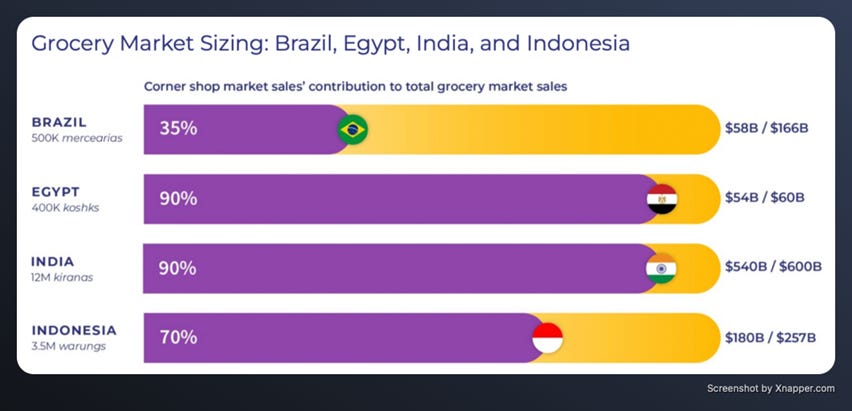
Despite corner shops representing such a large sector of these economies, innovation and digitisation has historically been slow, however that has begun to change in recent years. Over the last decade, many believed that larger e-commerce (e.g. Amazon and Flipkart in India) and organised retail chains (e.g. Reliance Retail in India, Transmart in Indonesia) would dominate, as we have largely seen take place across western markets. However as the numbers show, taking Asia as an example, culturally, consumers tend to like shopping at their local stores. Micro-retailers have built up close relationships with their local communities, are conveniently located, and are in-tune with local customer preferences and customs.
However, pain points remain right across the stack for small shopkeepers and they are indeed under threat from the larger e-commerce and retail juggernauts; from buying (sourcing products and managing supply from wholesalers) and managing (primarily inventory) to actually selling goods (payment options and customer experience) and finance (working capital, growth etc).
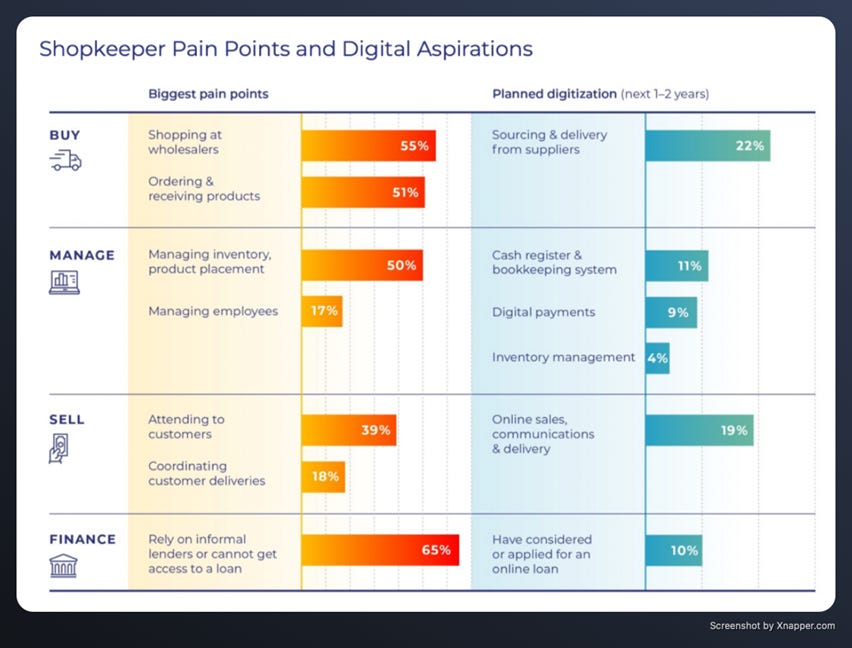
The vast majority of these businesses have been family owned for generations. In order to remain competitive, small business owners are increasingly either on the hunt, or at least open, to digitisation - and there are a number of ambitious Founders looking to solve their problems.
Given India represents over 50% of the >$900 billion global corner shop market, it is worth focusing on their remarkable “Kirana” (small mom & pop stores) network - one of the true powerhouses of the Indian economy.
Some staggering stats show that, even with the rise of Amazon and Flipkart in the country, just over 90% of FMCG sales in India continue to take place via Kirana stores. They contribute to 10% of India’s GDP and employ 8% of India’s workforce.
‘eB2B’ and Payment Digitisation represent two particularly interesting parts of the Kirana stack that innovative startups are looking to solve for.
Companies like Udaan, and Arzooo (an investment I worked on, prior to joining TEN13) are innovating on the eB2B side. Both companies were founded by previous Flipkart employees, with a deep understanding of the local market dynamics. Currently manufacturers, OEMs and brands don’t just supply small stores directly. Instead, there is an elaborate network of distributors who push the product down to the Kirana network. Players like Udaan, Arzooo, ShopX and others are looking to disrupt this equation, ultimately removing the middle man and linking the Brands / OEMs to the stores, by leveraging technology. This is clearly starting to work, with Udaan as one of India’s fastest growing unicorns.
On the payment digitisation side, innovation is taking place around POS and QR codes, with companies like Capital Float and M Swipe looking to unlock untapped digital spend, combining data analytics to also open up an increasing number of financing options for their smaller stores partners.
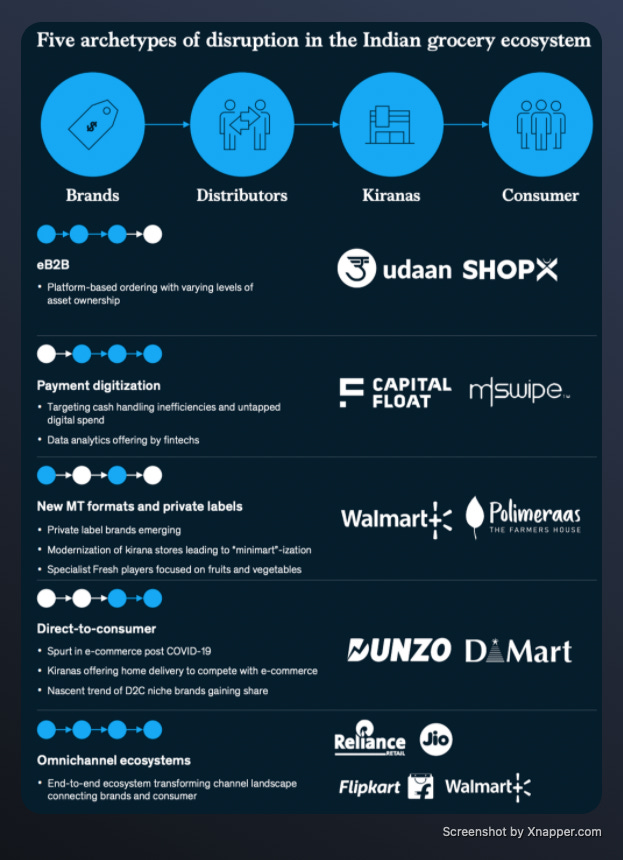
Source: Mckinsey
We still see this sector of many emerging economies as an exciting area for disruption. Additionally we continue to see superb talent spinning out from the big tech flywheel (e.g. from companies like Flipkart, Grab, Gojek, etc), producing Founders who have deep sector expertise and experience in solving some of the hardest problems at scale.